
イベント
終了2026年04月13日
Webinar Panel Discussion: The Iran War’s Implications for Sectarianism in the Middle East
開催日
2026年04月28日 (火) ~ 2026年04月28日 (火)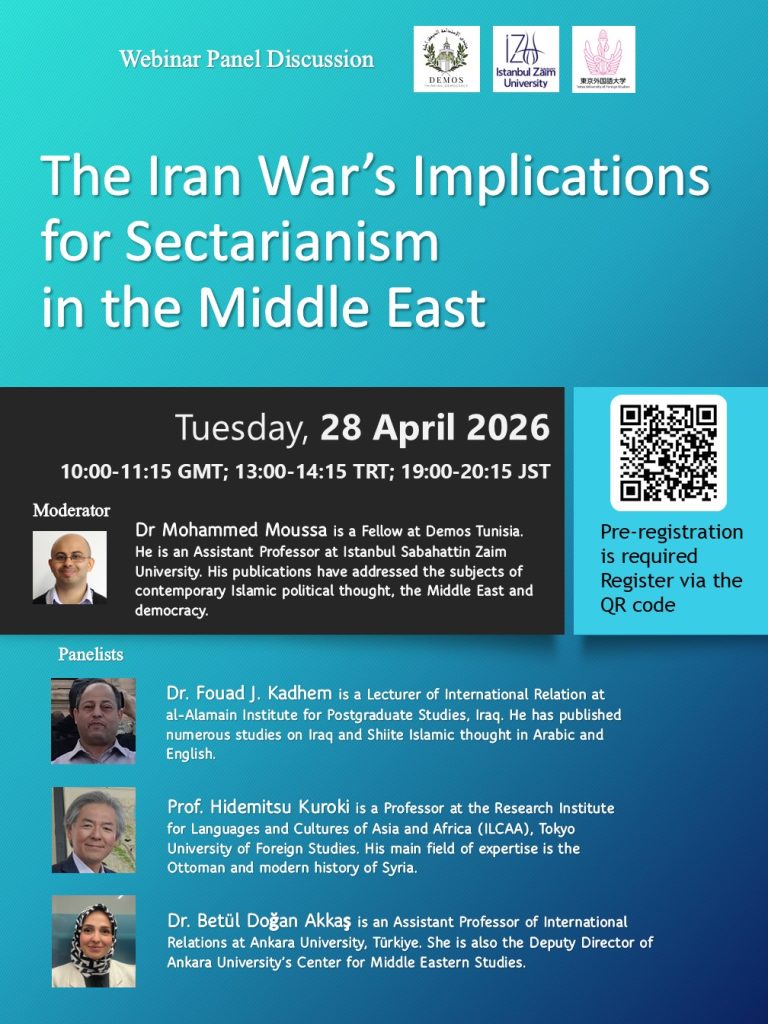
| 日時 | 2026年4月28日(火)19:00–20:15(JST) (10:00–11:15 GMT; 13:00–14:15 TRT) |
|---|---|
| 場所 | オンライン(ウェビナー) |
| 参加方法 | 要事前登録。 こちらからお申し込みください。リンクが届きます。 |
| 使用言語 | 英語 |
| 共催 | Core Project “Field Archiving of Memory: Dynamics of Cooperation within the Islamic Society” Research Institute for Languages and Cultures of Asia and Africa, Tokyo University of Foreign Studies; Demos Tunisia, Istanbul Sabahattin Zaim University’s Department of Political Science and International Relations |
| 問い合わせ | meis[at]aa.tufs.ac.jp ( [at] を@に変えて送信してください。) |
イラン戦争が中東の宗派対立に与える影響とは?
Sectarian divisions in the Middle East continue to be implicated in political rivalries and conflicts. The invasion of Iraq in 2003 set off a chain of events that created a conductive environment for the formation of political identities and groups seemingly driven by a zero-sum sectarian logic.
The ongoing Iran war involving ostensible cleavages between Persian and Arab on the one hand and Sunni and Shi’ite on the other hand is increasingly looking like it may turn into yet another American ‘forever war’ exacerbating ethnic and sectarian tensions.
While this war threatens to escalate in a region that is dominated by Sunni Muslims, the Middle East also contains majority and significant minority populations of Shi’ite Muslims in Iran, Azerbaijan, Bahrain, Iraq and Lebanon. During the last two and a half decades, this sectarian dimension has stoked fears of a ‘Shi’ite Crescent’ and the spectre of Iranian regional hegemony through its armed proxies. Iran’s targeting of the Gulf monarchies in the current conflict has revived concerns about their larger neighbour’s ambitions of late.
However, upon closer inspection, the membership of this Iran-led ‘Shi’ite Crescent’ or ‘Axis of Resistance’ reveals notable ethnic, sectarian and ideological differences. With the exception of Hezbollah and other Iraqi militant groups, the remaining groups are not only independent but pursue specific political and social goals.
Demos Tunisia, Istanbul Sabahattin Zaim University’s Department of Political Science and International Relations and Research Institute for Languages and Cultures of Asia and Africa (ILCAA), Tokyo University of Foreign Studies, are co-organising a webinar that will bring together a panel of experts to discuss the Iran war’s implications for sectarianism in the Middle East.
Moderator:
Dr. Mohammed Moussa is currently Fellow at Demos Tunisia. He is an Assistant Professor at Istanbul Sabahattin Zaim University. His publications have addressed the subjects of contemporary Islamic political thought, the Middle East and democracy. He is a co-editor of the volume Beyond Modernity (Rowman & Littlefield, 2023).
Speakers:
Dr. Fouad J. Kadhem is a Lecturer of International Relation at al-Alamain Institute for Postgraduate Studies, Iraq. He has published numerous studies on Iraq and Shiite Islamic thought in Arabic and English.
Prof. Hidemitsu Kuroki is a Professor at the Research Institute for Languages and Cultures of Asia and Africa (ILCAA), Tokyo University of Foreign Studies, specializing in Ottoman and Modern History of Syria. From 2005 to 2024, he was in charge of Japan Center for Middle Eastern Studies, ILCAA,. Between 2021 and 2025, he led the “Connectivity and Trust Building in Islamic Civilization” project in Japan.
Dr. Betül Doğan Akkaş is an Assistant Professor of International Relations at Ankara University, Türkiye. She is also the Deputy Director of Ankara University’s Center for Middle Eastern Studies.